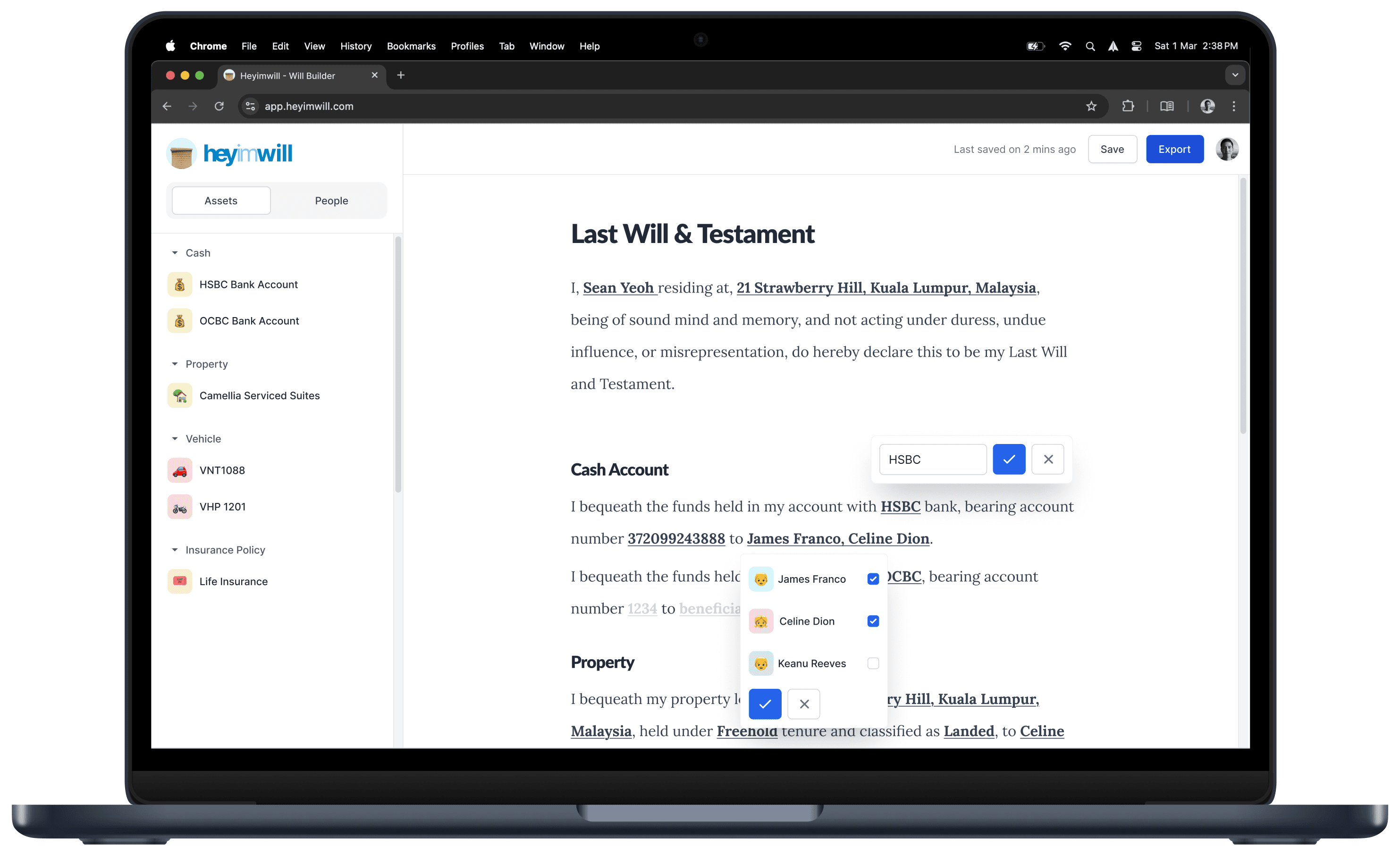
Is an Online Will Valid in Malaysia?

In short: Yes — a will you create online is fully valid in Malaysia, as long as you print the final document and sign it in wet ink in front of two non-beneficiary witnesses. The law cares about how the finished will is signed and witnessed, not about whether you drafted it on a laptop or on paper. What is not valid is a will that only ever exists as a digital file with an electronic signature.
This question comes up constantly, and the confusion is understandable. "Online will" can mean two very different things. Let's separate them — then walk through exactly what a legitimate online workflow looks like, where people slip up, and how online drafting compares to going straight to a lawyer.
Scope note: This applies to non-Muslims in Peninsular Malaysia under the Wills Act 1959. Muslims use wasiat under Syariah rules; Sabah and Sarawak have separate succession laws.
"Written online" vs "signed online" — the key distinction
| | Drafting online | Signing electronically | | --- | --- | --- | | What it means | You use a website or app to create the document | You "sign" with an e-signature and never print it | | Valid in Malaysia? | ✅ Yes | ❌ No | | Legal basis | Wills Act 1959 cares about the final signed paper | ECA 2006 excludes wills from e-signature rules | | Witnesses required? | Yes — at the offline signing step | N/A — already invalid |
So the headline answer is: drafting your will online is completely fine. The only step you can't do online is the signing — that still has to happen in person, on paper, with two witnesses present together (sections 5, 6, and 9 of the Wills Act 1959).
Why the signature still has to be physical
Malaysia's Wills Act 1959 requires a will to be in writing, signed by you, and witnessed by two people present with you. Notably, Malaysia's Electronic Commerce Act 2006 — which gives electronic signatures legal force for many commercial documents — specifically excludes wills from its scope (section 2 and the First Schedule). That's why even the most polished online tool must end with you printing and wet-signing the document.
If you skip that step, you don't have a valid will — you have a nicely formatted draft sitting in a database. Courts grant probate on the original signed will, not on your account login.
What a good online will tool actually does
A well-built online tool doesn't try to dodge the law — it makes the legitimate process faster and less error-prone. When I built Heyimwill and then used it myself, the tool:
- 1Walked me through listing assets so I didn't forget anything (40+ asset types to pick from).
- 2Flagged gaps and potential issues before I finalised — including reminder prompts about EPF and
insurance nominations, which a will cannot override.
- 1Let me connect with a vetted lawyer to review the draft.
- 2Produced a clean final PDF with clear signing instructions — print, sign in wet ink, two
non-beneficiary witnesses in the same room.
The online part removes the friction and the guesswork. The offline signing keeps it legal. For the full validity requirements, see what makes a will valid in Malaysia.
The complete online-to-valid workflow
Here's the end-to-end path that actually works:
| Step | Where | What happens | | --- | --- | --- | | 1. Draft | Online (app or tool) | List assets, beneficiaries, executor | | 2. Review | Online + optional lawyer call | Catch witness errors, ambiguity | | 3. Finalise | Online | Generate final printable document | | 4. Print | Offline | Physical paper copy | | 5. Sign | Offline, in person | You + 2 witnesses, same room, wet ink | | 6. Store | Offline | Original in safe place; executor informed |
Steps 4–6 cannot be skipped. No reputable Malaysian service should claim otherwise.
Worked example: Siti drafts online, signs at home
Siti Aminah, 38, uses an online will tool one evening after her second child is born. She names her husband Kumar as main beneficiary and executor, lists her condo and savings accounts, and schedules a 30-minute lawyer review for the following week.
The lawyer flags that Kumar cannot also witness the signing (he's a beneficiary — Wills Act section 9). Siti invites two colleagues, Mei Ling and Farid, who inherit nothing, to her home on Saturday.
They gather in the living room. Siti prints the final will, signs at the bottom in pen, then Mei Ling and Farid each sign as witnesses in Siti's presence. She stores the original in a home safe and emails her executor instructions plus a copy of the key location.
Siti's will was drafted online but is legally valid because the execution followed section 6. She also updates her EPF nomination in i-Akaun — something the online tool reminded her the will cannot do.
Is an online will as "strong" as a lawyer-drafted one?
Validity and strength are different things (I explain this in what makes a will valid). An online-drafted will that a lawyer has reviewed can be just as strong as a fully lawyer-drafted one — often at lower cost and with less back-and-forth. A pure DIY template with no review is valid but riskier: ambiguity and missed assets are where disputes start.
| Approach | Valid if signed correctly? | Typical strength | | --- | --- | --- | | Free template, no review | Yes | Low–medium | | Online tool, no review | Yes | Medium | | Online + lawyer review | Yes | High | | Full lawyer engagement | Yes | High (best for complex estates) |
See do you need a lawyer and what a will costs.
Common mistakes with online wills
- 1Never printing. The account holds a draft, not a will. Print the final version.
- 1E-signing the PDF. Tempting, but excluded under the Electronic Commerce Act 2006.
- 1Witnessing by video call. Witnesses must be physically present together (section 6). A Zoom
signing is not valid.
- 1Using a beneficiary as witness. Section 12 may void their gift. Online tools should warn you;
still double-check.
- 1Assuming the platform stores your "legal will." The signed paper original is what matters for
probate. See how to store your will.
- 1Ignoring EPF/insurance. Online drafting doesn't update nominations. Do that separately.
- 1Choosing a non-Malaysia template. UK/US forms may use wrong terminology or miss local rules
(Distribution Act, nomination laws, Muslim/Sabah/Sarawak caveats).
Edge cases
- Can I email the will to witnesses to sign later? No. Everyone must be in the same room for the
initial signing ceremony.
- Can I update my will online without re-signing? Changes in the app are drafts until you print
and execute a new will (or valid codicil with the same witnessing formalities).
- What about password-protected PDFs? Fine for storage — but probate needs the signed original,
not an encrypted file nobody can open.
- Muslim users on generic "online will" sites: Standard Wills Act tools don't produce a valid
wasiat for Muslims. Use a Syariah-qualified service.
- Overseas while using a Malaysian tool: You can draft online from abroad, but signing should
still follow Malaysian law if the will is meant to govern Malaysian assets — and witnesses must be physically present with you.
Online will vs traditional lawyer: an honest comparison
People sometimes worry that "online" means "less legitimate." It doesn't — if you complete the offline signing. Here's how the paths compare in practice:
| Factor | Online + lawyer review | Traditional lawyer only | | --- | --- | --- | | Drafting speed | Fast — guided forms | Slower — meetings, back-and-forth | | Cost transparency | Often fixed upfront | May be quoted hourly | | Validity | Same Wills Act requirements | Same Wills Act requirements | | Complex trusts / business | May still need full engagement | Natural fit | | Signing ceremony | You arrange witnesses | Lawyer may host signing | | EPF/nomination reminders | Good tools flag this | Depends on lawyer practice |
I built Heyimwill because I wanted the speed of online drafting with the safety net of a real Malaysian lawyer review — not because the law treats online drafts differently. The law treats the signed paper as the will.
What "digital will" products abroad do differently
In some countries, fully digital wills are gaining ground. Malaysia is not there yet. The Electronic Commerce Act 2006 deliberately carved wills out of e-signature validity. Any product marketing "sign on your phone" for a Malaysian non-Muslim will should be treated with scepticism unless it still ends in print, wet ink, and two witnesses.
Red flags when evaluating online will services
- 1Claims you can skip witnesses
- 2Claims government registration is required (it isn't, for validity)
- 3No Malaysia-specific legal basis cited
- 4Muslim wasiat generated from a generic Wills Act template
- 5Stores your "executed will" only in the cloud with no print-and-sign step
- 6Unclear privacy policy or data sharing with unknown third parties
After you sign: what to do with the online draft
Your app account may still hold the draft PDF. That's useful as a backup — but it's not your will. The signed original is. I recommend:
- 1Store the original in a fire-resistant safe or with a trusted person
- 2Give your executor a sealed copy or clear location instructions
- 3Delete or archive outdated unsigned PDFs so nobody mistakes them for the current will
- 4Set a calendar reminder to review nominations and the will every few years
The online tool got you to the signing table. What happens after that is entirely offline — and entirely your responsibility until you tell your executor where to look.
What your witnesses need to know (and what they don't)
Witnesses are not making a moral endorsement of your choices. They're attesting a fact: I saw this person sign this document. Brief them before the ceremony:
Tell them:
- They must be present in the same room when you sign
- They must sign immediately after you, in your presence
- They should not be beneficiaries or married to beneficiaries
- They should use the same pen if possible and sign where indicated
Don't require them to:
- Read the will
- Agree with your decisions
- Remember the contents years later (though they may be called to testify if disputed)
In Ahmad's example above, his children thought witnessing was a formality of family support. Section 12 turned it into an inheritance problem. Choose witnesses who understand the independence requirement — even if that feels awkward among family.
- [ ] Tool is designed for Malaysian non-Muslim estates (Wills Act 1959)
- [ ] All assets listed, including note of EPF/insurance nominations
- [ ] Beneficiaries named with full legal names and IC numbers
- [ ] Executor and alternate named; they've agreed
- [ ] Lawyer review completed (recommended)
- [ ] Final document downloaded and printed
- [ ] Two independent witnesses arranged (not beneficiaries)
- [ ] Wet-ink signing ceremony completed in one sitting
- [ ] Original stored; executor knows location
- [ ] EPF and insurance nominations updated separately
Frequently asked questions
- Can I make a legally valid will online in Malaysia?
- Yes. You can draft your will using an online tool and it will be fully valid — provided you print the final version and sign it in wet ink in front of two witnesses who are not beneficiaries (Wills Act 1959, sections 6 and 9). The online step is the drafting; the signing must still be done physically and in person.
- Is an electronically signed will valid in Malaysia?
- No. Wills are specifically excluded from Malaysia's Electronic Commerce Act 2006, so an e-signature does not make a will valid. You must sign a printed copy by hand, witnessed by two non-beneficiaries present at the same time.
- Do I still need witnesses if I use an online will service?
- Yes. No online service can remove the witnessing requirement. After the tool generates your final will, you must print it and sign it in the physical presence of two witnesses who receive nothing under the will. Reputable tools give you exact instructions for this step.
- Is a will made online safe and private?
- It can be, if the service stores your data securely and only shares it with the lawyer you choose to engage. Read the privacy policy. The signed original should be kept somewhere safe and accessible to your executor — see how to store your will.
- Is an online will cheaper than a lawyer?
- Usually yes for drafting — especially with transparent review fees. Complex estates (businesses, trusts, overseas assets) may still need full lawyer engagement. See cost of writing a will.
- Can I use a foreign online will service for Malaysia?
- Risky. The document must comply with the Wills Act 1959 and Malaysian succession law. A Malaysia- focused tool or local lawyer is safer.
- What happens if I die with only a digital draft in an app?
- You likely die intestate — the Distribution Act 1958 formula applies, not your draft. See dying without a will.
- Does Heyimwill or any app register my will with the government?
- No Malaysian will requires government registration for validity. Registration myths are common; validity comes from proper signing and witnessing.
Ready to write your will?
Build your will online and secure peace of mind for your loved ones.
Create Will