
How to Write a Will in Malaysia: The Complete 2026 Guide
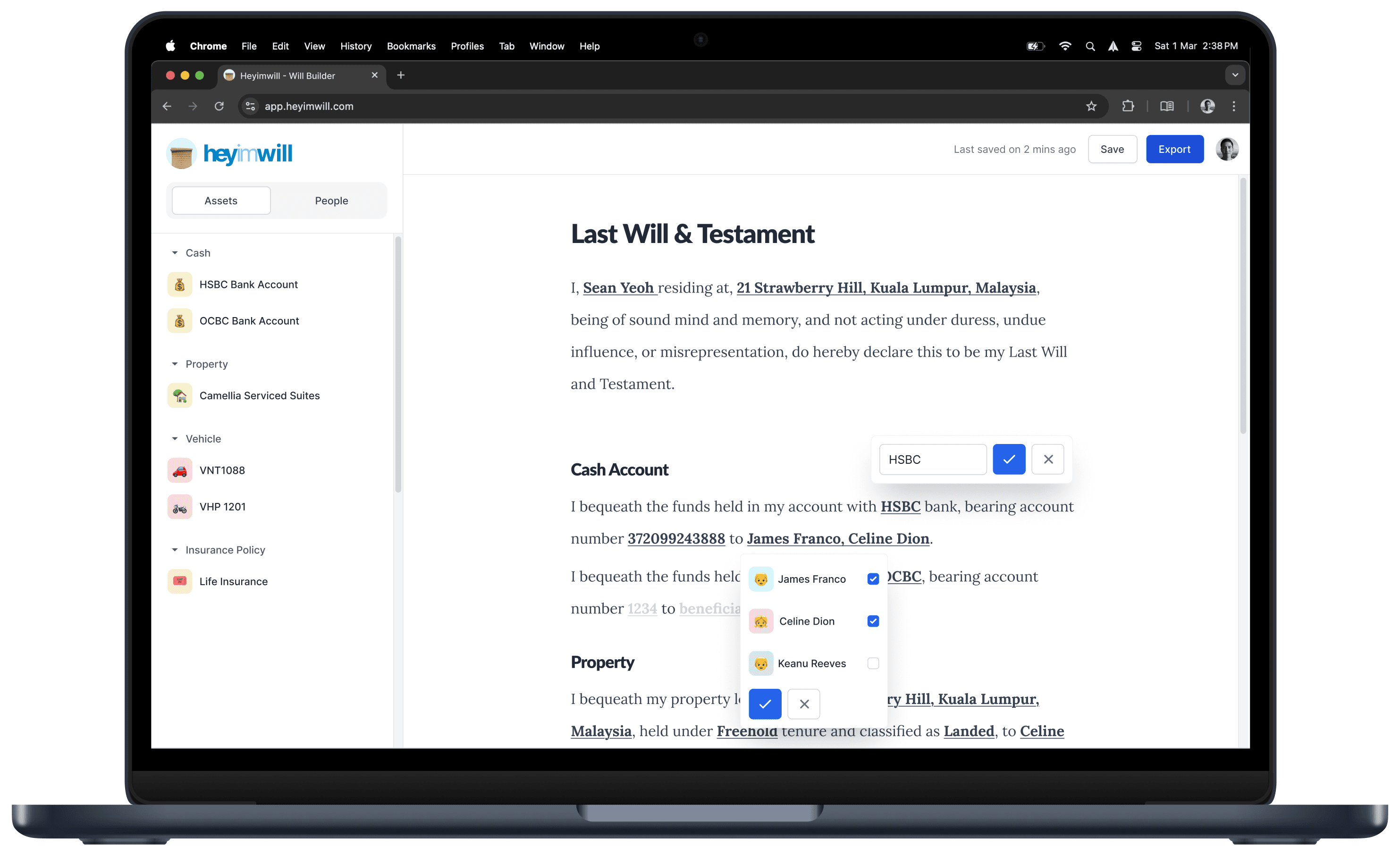
In short: To write a valid will in Malaysia (non-Muslim), you must be at least 18, of sound mind, and sign a written will in front of two witnesses who are not beneficiaries. You don't need a lawyer, a stamp, or government registration for it to be legally binding — though a lawyer makes it stronger. This guide walks through the whole process, step by step, with checklists, worked examples, and the EPF/insurance trap most people miss.
I wrote my first will in 2023, long before Heyimwill existed. Since then I've read stacks of estate- planning books, talked to lawyers, and — after we built the platform — gone through the entire process again as our own first customer. This guide is the plain-English version of everything I wish someone had told me at the start.
A quick, important note: this article is for non-Muslims in Peninsular Malaysia, whose wills are governed by the Wills Act 1959 (see section 4 on application). Rules differ for Muslims (see the section below) and can differ in Sabah and Sarawak. This is general information, not legal advice. If your situation is unusual — blended families, business assets, overseas property — speak to a qualified Malaysian estate lawyer.
Do you actually need a will in Malaysia?
If you own anything — a bank account, EPF savings, a car, a home, investments — and you'd have a preference about who receives it, then yes. Without a will you die intestate, and the Distribution Act 1958 (section 6, as amended) decides who gets what using a fixed formula that may not match your wishes at all.
Here's the part people underestimate: dying without a will doesn't just change who inherits — it makes the process slower, costlier, and more stressful for the people you leave behind. They'll need to find someone to volunteer as administrator, often provide two sureties (guarantors) under the Probate and Administration Act 1959, and wait through a longer court process. A will removes most of that friction. (More in what happens if you die without a will.)
A worked example: the Tan family
Imagine Tan Wei Ming, 42, married to Siti Nurhaliza Tan (non-Muslim; they married under civil law). They have two children, Daniel (14) and Emily (11). Wei Ming's elderly mother, Puan Tan Ah Lian, still lives with them.
Wei Ming assumes that if anything happens to him, "everything goes to Siti and the kids." Under the Distribution Act, if he dies without a will with spouse, children, and a surviving parent all in the picture, the estate splits 1/4 to Siti, 1/2 to the children (shared equally), and 1/4 to his mother — not "everything to my wife."
Wei Ming also has RM280,000 in EPF with his brother Ahmad nominated from ten years ago when he was single. His will cannot change that. EPF pays Ahmad directly. His insurance with a valid nomination to Siti bypasses the estate too.
A will lets Wei Ming: leave his personal assets to Siti outright if he chooses; name Siti as executor with his sister Mei Ling as backup; set up a simple trust clause for the children until they turn 21; and — critically — remind him to update his EPF nomination to Siti. The will handles what the law allows; nominations handle what the will cannot touch.
What makes a will legally valid in Malaysia?
Under the Wills Act 1959, a valid will needs three core things:
- 1You're at least 18 years old (section 5 — testamentary capacity).
- 2You're of sound mind — you understand what a will is, what you own, and who you're giving it
to (also section 5).
- 1It's in writing, signed by you, and witnessed by two people who are present together when you
sign — and who are not beneficiaries (nor married to a beneficiary) (sections 6 and 9).
That's genuinely it. No notarisation, no stamping, no government registration is required. Your paper will is legally binding the moment it's properly signed and witnessed. For the full detail, including the witness rules that trip people up and what happens when a beneficiary signs as witness (section 12 — the gift to that witness is void), read what makes a will valid in Malaysia.
"Valid" is not the same as "strong." A will can be valid but still vague, incomplete, or easy to dispute. That's the gap a lawyer closes.
| Validity requirement | Wills Act 1959 | Common misconception | | --- | --- | --- | | Age | s. 5 — at least 18 | "I need to be older to make a will" | | Mental capacity | s. 5 — sound mind | "A doctor must certify me" | | Form | s. 6 — writing + signature + 2 witnesses | "It must be stamped like a tenancy agreement" | | Witnesses | ss. 6, 9 — not beneficiaries | "My spouse can witness if they're also inheriting" |
How to write your will: 5 steps
Step 1 — List your assets
Start by writing down what you own. In my case that meant:
- Bank accounts (local and foreign)
- Investment and brokerage accounts
- My vehicle
- Property (check how it's held — sole name vs joint tenancy)
- Personal items with sentimental or real value
- Business interests, if any
Two things people forget: digital assets (crypto wallets, domain names, online accounts) and who cares for dependants or pets. See what assets to include in your will — it also covers the single biggest mistake Malaysians make: assuming a will controls their EPF and insurance. (It doesn't. More below.)
Practical tip: Open your banking app, EPF i-Akaun, insurance portal, and land title search. List account numbers or policy numbers somewhere your executor can find them — not in the will itself if you're worried about privacy while alive; a sealed letter with the will works.
Step 2 — Decide who gets what
Assign each asset (or a percentage of your estate) to the people or causes you choose. Be specific: full names, IC numbers, relationships. Name a backup beneficiary in case someone predeceases you.
You can gift specific items ("my Rolex watch to my son Daniel") or divide by percentage ("50% of my residual estate to my wife, 25% each to my two children"). Residual estate means what's left after specific gifts and debts.
Under section 2 of the Wills Act 1959, you can dispose of any property you're entitled to at death, subject to other laws (like nominations and joint ownership). You cannot will away assets you don't own — and you cannot override a valid EPF or insurance nomination with a will clause.
Step 3 — Choose an executor
Your executor is the person who carries out your will — applying for the Grant of Probate under the Probate and Administration Act 1959, gathering assets, paying debts, and distributing what's left. Pick someone trustworthy, organised, and willing (always ask first), and name an alternate. See how to choose an executor.
For smaller estates, your executor may instead pursue a Distribution Order under the Small Estates (Distribution) Act 1955 (threshold RM5 million since July 2024) or Amanah Raya summary administration for movable-only estates up to RM600,000. Naming a capable executor who knows which route to take saves months of delay.
Step 4 — Get it drafted and reviewed
You can DIY, use a guided tool, or engage a lawyer. When I went through Heyimwill, a lawyer reviewed my draft over a 30-minute call and caught real issues — I'd accidentally listed a beneficiary as a witness, and hadn't given my executor enough detail to find certain assets. That review is cheap insurance. See do you need a lawyer and what a will costs.
Whether you draft online or on paper, the output must be a printed document ready for wet-ink signing. See is an online will valid for how digital drafting fits the legal requirements.
Step 5 — Sign, witness, and store it
Print the final will, sign it in wet ink in front of two non-beneficiary witnesses who are in the same room, make a few copies, and tell your executor where the original is kept. A will nobody can find is as good as no will. See how to store, update and revoke your will.
Signing ceremony checklist:
- 1Print the final version — no handwritten edits after printing if you can avoid it.
- 2Gather two witnesses who receive nothing under the will and are not married to beneficiaries.
- 3All three of you in the same room: you sign, then each witness signs in your presence and each
other's.
- 1Date the will clearly.
- 2Store the original; give your executor a copy or clear instructions on where to find it.
The EPF and insurance trap (read this before anything else)
This is the mistake I see most often, so I'll say it plainly: your will does not control your EPF savings or your nominated insurance payouts.
- Under the Employees Provident Fund Act 1991 and EPF Regulations 2001 (Regulation 4 and
related provisions), an EPF nomination cannot be revoked by a will. EPF pays your nominee directly, bypassing your estate.
- Under the Financial Services Act 2013 (Schedule 10), an insurance nomination works the same
way — a will can't override it.
So if your will says one thing and your EPF/insurance nomination says another, the nomination wins. The fix isn't in your will — it's to log in and update your nominations separately. Full explanation in what assets to include in your will.
In the Tan family example above, Wei Ming's outdated EPF nomination to his brother Ahmad would pay out regardless of what his will says. Updating EPF i-Akaun takes minutes; fixing it after death is impossible.
Common mistakes (and how to avoid them)
- 1Assuming your spouse gets everything. The Distribution Act formula may give shares to
children and parents too. A will overrides the default — but only if it exists and is valid.
- 1Using a beneficiary as witness. The will may stay valid, but under section 12 of the Wills
Act 1959, the gift to that witness-beneficiary is void. I've seen families discover this too late.
- 1Forgetting EPF and insurance nominations. Your will is not the master document for these
assets. Check nominations every few years and after major life events.
- 1Leaving no instructions for the executor. Account numbers, lawyer contacts, and location of
title deeds matter. Your executor shouldn't have to guess.
- 1Storing the will where nobody can find it. Safe deposit boxes can be frozen on death unless
your bank's procedure is understood in advance. Tell your executor.
- 1Never updating after marriage, divorce, or new children. An old will may still be valid — but
it may no longer reflect your wishes. See how to store, update and revoke your will.
- 1Trying to sign digitally. Electronic signatures are excluded for wills under the Electronic
Commerce Act 2006. Print and wet-sign.
Edge cases worth knowing
- Jointly owned property: Property held as joint tenants typically passes to the surviving
owner by survivorship — your will may not control that share. Tenants in common can be willed separately. Check your title.
- Muslims: The Wills Act 1959 does not apply. Muslim estates use faraid and a wasiat can
only dispose of up to one-third of net assets to non-heirs (with conditions). Hibah (lifetime gift) is another common tool.
- Sabah and Sarawak: Sarawak has its own Wills Ordinance; Sabah has separate succession
rules. Don't assume Peninsular templates apply unchanged.
- Beneficiaries who are minors: You can leave assets to children via a trust clause or appoint a
guardian for personal welfare — but understand that someone must hold assets until they reach the age you specify.
- Overseas assets: Malaysian wills may cover foreign assets, but foreign probate may still be
needed. Complex estates often need specialist advice.
Your will-writing checklist
Use this before you sign:
- [ ] I am 18 or older and of sound mind
- [ ] I have listed all major assets (and noted what passes outside the will)
- [ ] EPF and insurance nominations match my current wishes
- [ ] Beneficiaries are named with full legal names and IC numbers
- [ ] Backup beneficiaries are named
- [ ] Executor and alternate executor agreed to serve
- [ ] Guardian named for minor children (if applicable)
- [ ] Specific gifts and residual estate clearly worded
- [ ] Two witnesses chosen — neither beneficiaries nor spouses of beneficiaries
- [ ] Final document printed for wet-ink signing
- [ ] Original stored safely; executor knows the location
- [ ] Lawyer review completed (recommended for most people)
What does a will cost in Malaysia?
| Route | Typical cost | Best for | | --- | --- | --- | | Pure DIY (template) | Free to low | Very simple estates; higher error risk | | Online guided + lawyer review | Mid-range, transparent fees | Most people wanting a valid and strong will | | Full traditional lawyer engagement | Higher, varies by firm/complexity | Complex estates, trusts, business assets |
There's no inheritance tax or estate duty in Malaysia — estate duty was abolished on 1 November 1991, so the cost is really about drafting and, later, administration. Administration fees for smaller estates under the Small Estates (Distribution) Act 1955 are 0.2% on the first RM2 million and 0.3% on RM2,000,001–RM5,000,000 (threshold raised to RM5 million in July 2024). Full breakdown in how much a will costs.
What about Muslims?
The Wills Act 1959 applies to non-Muslims only (section 4). Muslim estates are distributed under faraid (fixed Quranic shares) via the Syariah framework. A Muslim can make a wasiat to gift up to one-third of the net estate to non-heirs (bequests beyond that, or to existing heirs, generally need the other heirs' consent), and hibah (a lifetime gift) is another common tool. If you're Muslim, speak to a Syariah-qualified estate planner — this guide is not for you.
What happens to the will after you die?
Your executor takes the will to the High Court to obtain a Grant of Probate under the Probate and Administration Act 1959, which gives them legal authority to administer your estate. The court seals the will and confirms the executor's appointment — only then can banks and registries release sole-name assets at scale.
Smaller estates may go through the Land Office instead. Under the Small Estates (Distribution) Act 1955 (as amended in 2022, effective July 2024), estates up to RM5 million can receive a Distribution Order via the MyLAND portal. Official processing guidance suggests roughly 4–6 months. Order fees are 0.2% on the first RM2 million and 0.3% on RM2,000,001–RM5,000,000.
Amanah Raya Berhad handles movable-only estates up to RM600,000 under summary administration. Estates with movables below roughly RM50,000 may qualify for a simplified Direction — confirm current practice with Amanah Raya.
When drafting your will, it helps to leave your executor a one-page "road map": approximate estate value, whether land is involved, where accounts are held, and which route you expect they'll use. That single page can save weeks of guesswork. See probate in Malaysia explained.
Choosing between specific gifts and percentage splits
You don't have to pick one approach. Many strong wills combine both:
- Specific gifts for items with sentimental value (jewellery, heirlooms, a named vehicle).
- Percentage of residue for everything else after debts and specific gifts are paid.
If you only list specific items and forget a "residue" clause, assets you acquire after writing the will — or items you forgot to mention — may fall into partial intestacy. A catch-all residue clause ("I give the rest of my estate to…") prevents that gap.
Frequently asked questions
- Do I need a lawyer to write a will in Malaysia?
- No. A will is valid without a lawyer as long as you're 18+, of sound mind, and sign it before two non-beneficiary witnesses (Wills Act 1959, sections 5 and 6). A lawyer isn't required for validity, but a review helps make the will clear, complete, and harder to dispute — which matters most when your estate is anything but simple.
- Does my will need to be stamped or registered?
- No. Unlike a tenancy agreement, a will doesn't need to be stamped, notarised, or registered with any government body to be valid. It becomes legally binding the moment you sign it correctly in front of two qualified witnesses. You should still store the original safely and tell your executor where it is.
- Can I write my own will by hand?
- Yes. A handwritten (or typed) will is valid in Malaysia if it meets the Wills Act 1959 requirements — in writing, signed by you, and witnessed by two non-beneficiaries present together. The risk with pure DIY isn't validity; it's ambiguity and missed assets that cause disputes later.
- Does my will cover my EPF and insurance?
- Usually no. A valid EPF or insurance nomination is paid directly to your nominee and cannot be overridden by your will. Update those nominations separately with EPF and your insurer to make sure they reflect your current wishes.
- Is there inheritance tax in Malaysia?
- No. Malaysia abolished estate duty on 1 November 1991 and currently has no inheritance tax. Your beneficiaries don't pay tax to receive their inheritance, though the estate must still settle any outstanding debts before distribution.
- Can I make a will online and still have it be valid?
- Yes — if you print the final document and sign it in wet ink with two witnesses. Drafting online is fine; signing electronically is not. See is an online will valid in Malaysia.
- What happens if I die without a will?
- Your estate is distributed under the Distribution Act 1958 formula, and someone must apply for Letters of Administration — often with sureties. It's slower and more stressful than probate with a valid will. See dying without a will.
- How often should I update my will?
- After every major life event: marriage, divorce, birth or death of a beneficiary, significant new assets, or a move overseas. Even without those events, a review every 3–5 years catches outdated nominations and executor choices.
- Can my will cover assets in Sabah or Sarawak?
- A Peninsular Malaysian will may cover assets in East Malaysia, but succession and land law can differ — especially in Sabah. If you hold property there, confirm with a lawyer familiar with that state's rules before relying on a standard Peninsular template.
- What is a residuary clause and why does it matter?
- A residuary clause gifts everything left after specific bequests and debts — the "rest and residue" of your estate. Without it, assets you forgot to list may not pass under your will as you intended. Every complete will should include one.
Ready to write your will?
Build your will online and secure peace of mind for your loved ones.
Create Will