Do You Need a Lawyer to Write a Will in Malaysia?

In short: No — you do not need a lawyer to write a valid will in Malaysia. As long as you're 18+, of sound mind, and sign in front of two non-beneficiary witnesses, your will is legally binding. But a lawyer's review is worth it more often than people think, because "valid" and "strong" aren't the same thing — and a review catches the mistakes that cause disputes later.
I'll give you the honest answer, because I've been on both sides of this: I wrote my first will myself, and later ran my own draft past a lawyer through Heyimwill. Both have their place.
This article is for non-Muslims in Peninsular Malaysia (Wills Act 1959). Muslims use wasiat and faraid with different requirements; Sabah and Sarawak have their own succession laws. General information, not legal advice.
The legal answer: no, a lawyer isn't required
The Wills Act 1959 doesn't mention lawyers at all. A will is valid if it meets three conditions under s.5:
- 1You're at least 18 years old.
- 2You're of sound mind — you understand what a will is, what you own, and who you're giving it to.
- 3It's in writing, signed by you, and witnessed by two people present together who are not
beneficiaries (nor married to a beneficiary).
No notarisation. No stamping. No government registration. No lawyer's signature. Your handwritten will on a piece of paper is legally binding the moment it's properly signed and witnessed. See what makes a will valid.
So the real question isn't "is it allowed?" — it's "when is a lawyer worth it?"
Valid vs strong: the gap most people miss
| | Valid will | Strong will | | --- | --- | --- | | Meets Wills Act formalities | Yes | Yes | | Clear, unambiguous language | Maybe | Yes | | Complete asset coverage | Maybe | Yes | | Executor can find and administer assets | Maybe | Yes | | Resistant to challenge | Weak | Strong | | Handles edge cases (marriage, divorce, predecease) | Unlikely | Yes |
A will can be valid but weak — and a weak will causes the same grief as no will: delays, disputes, and assets stuck behind probate for months.
When DIY (or online) is fine
For a simple, clear estate, a well-structured DIY or online-drafted will can do the job:
- You have a straightforward asset list (savings, a car, maybe one property).
- Your wishes are simple (e.g. everything to your spouse, then your children).
- Your family situation isn't contentious.
- You're careful about the witnessing rules.
- Your EPF and insurance nominations already match your wishes (see
what assets to include).
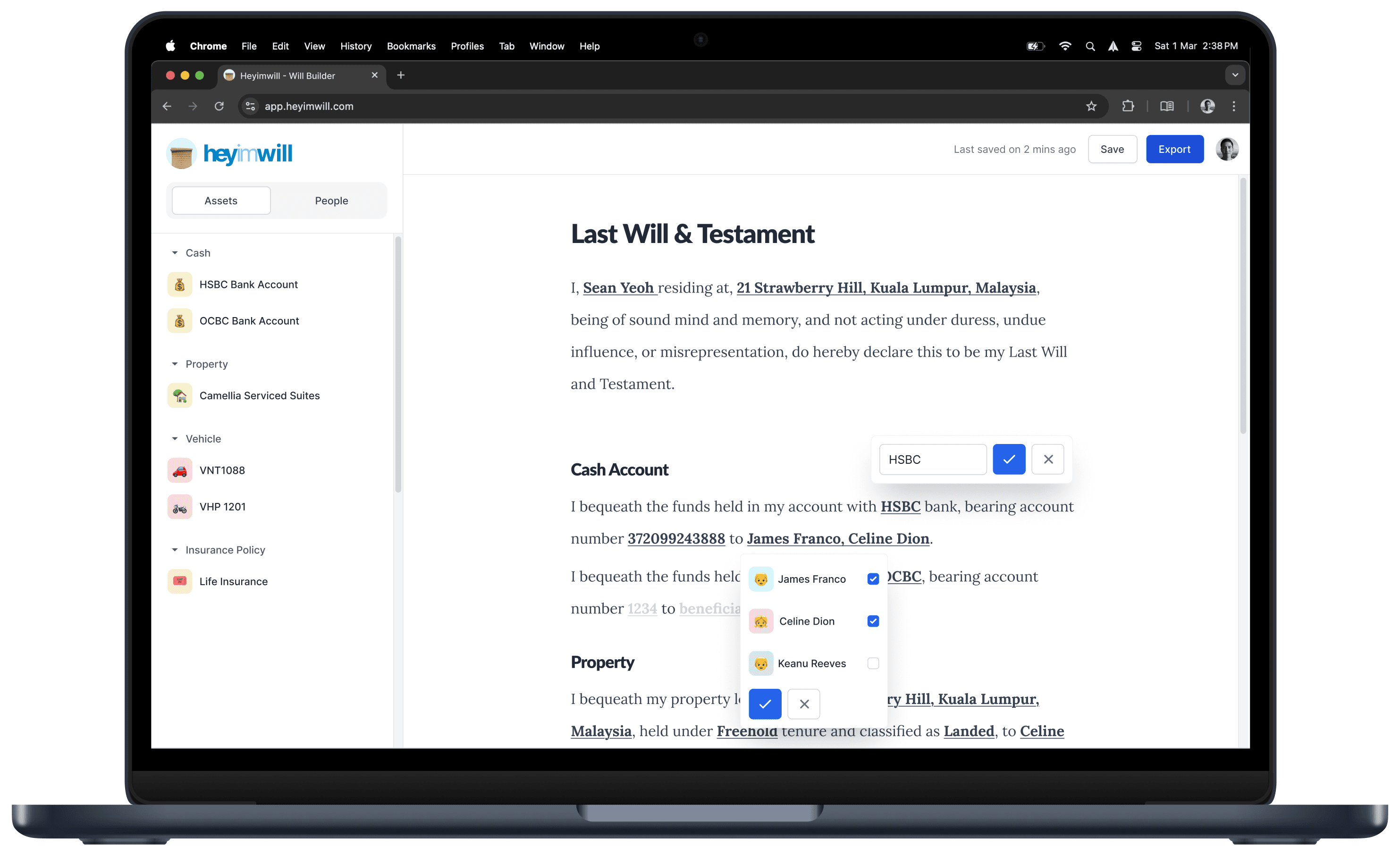
An online tool helps here by structuring the process and flagging gaps, so you don't forget assets or misword a clause. See is an online will valid.
DIY will: what you still must get right
Even for a simple will, these formalities are non-negotiable under the Wills Act:
| Requirement | Wills Act reference | Common slip-up | | --- | --- | --- | | Written document | s.5(1) | Verbal promises don't count | | Signed by testator | s.5(2) | Forgetting to sign | | Two witnesses, present together | s.5(2) | Witnesses signing on different days | | Witnesses not beneficiaries | s.9 | Child who inherits also witnesses | | Testator 18+ and of sound mind | s.4 | Not an issue for most adults |
When you should involve a lawyer
Get professional advice if any of these apply:
| Trigger | Why it matters | | --- | --- | | Blended family | Stepchildren, second marriage, children from different relationships — Distribution Act defaults may not match your wishes | | Business interests | Company shares, partnerships, shareholder agreements may restrict how shares pass | | Overseas assets | Foreign property or accounts may need separate foreign wills or probate | | Trusts or conditional gifts | "To my child when they turn 25," special-needs dependants — require precise trust language | | You expect disputes | Excluding a child, unequal splits, estranged relatives — need careful drafting to reduce challenge risk | | Large or complex estate | More value and more moving parts means more to get wrong | | Guardianship of minor children | Beyond naming a guardian — financial provision, trust structures | | Tenants-in-common property | Your share passes via will; needs clear description of which share |
What a review actually catches (a real example)
When my own draft was reviewed, the lawyer — in about 30 minutes — caught things I'd never have spotted:
- I'd listed a beneficiary as a witness (which would have voided their gift under Wills Act s.9).
- I hadn't included enough detail for my executor to locate certain assets.
- She suggested adding a personal message to loved ones — something I hadn't considered.
- She flagged that my EPF nomination still named a family member I'd intended to change.
None of those were "validity" problems on paper. They were strength problems — the kind that quietly cause delay, confusion, or conflict when the will is actually used.
What lawyers typically check in a review
| Area | What they look for | | --- | --- | | Formalities | Signing, witnessing, attestation clause | | Beneficiary-witness conflict | s.9 — gift to witnessing beneficiary is void | | Revocation clause | Does the will properly revoke prior wills? | | Appointment of executor | Named? Alternate named? | | Asset descriptions | Specific enough for executor to locate? | | Residuary clause | Is there a catch-all for assets you forgot to list? | | Marriage contemplation | If recently married, was will made in contemplation of marriage (s.12)? | | Nomination alignment | EPF/insurance nominations vs will — flag mismatches | | Ambiguity | Clauses that could be read two ways |
Worked example: DIY vs lawyer for two different people
Case 1: Nurul — DIY is fine
Nurul binti Osman, 29, single, junior architect in Shah Alam.
| Factor | Nurul's situation | | --- | --- | | Assets | RM45,000 EPF (nominated to mother), RM20,000 savings (Maybank), Proton Saga, personal items | | Wishes | Everything to mother, with small gifts to two siblings | | Family | Close, no conflict | | Complexity | Low |
Recommendation: DIY or online will. Total cost: RM0–RM200 (online tool). She should still verify her EPF nomination matches her wishes (mother as beneficial nominee) and sign with two non-beneficiary witnesses.
Case 2: Tan — lawyer strongly recommended
Tan Kok Wai, 55, second marriage, runs a small manufacturing company in Johor.
| Factor | Tan's situation | | --- | --- | | Assets | Factory (tenants-in-common with business partner), company shares (60%), two properties, EPF, three insurance policies, overseas bank account (Singapore) | | Wishes | Wife from second marriage gets residence; children from first marriage get company shares; stepchild from second marriage gets education trust | | Family | First wife's children resent second wife; potential dispute likely | | Complexity | High |
Recommendation: Full lawyer drafting, not just review. Estimated cost: RM3,000–RM8,000+ depending on firm and complexity. A DIY will here risks invalid gifts, unenforceable trust clauses, shareholder agreement conflicts, and a will challenge that could tie up the estate for years.
The cost difference between Nurul and Tan isn't about "can they write a will" — both can. It's about what happens when the will is actually used.
Cost comparison: three approaches
| Approach | Typical cost (Peninsular Malaysia) | Best for | | --- | --- | --- | | Pen-and-paper DIY | Free | Very simple estates; you understand formalities | | Online will tool | RM0–RM500 | Simple estates; want structure and reminders | | Online draft + lawyer review | RM500–RM2,000 | Most people — balance of cost and safety | | Full lawyer drafting | RM1,500–RM10,000+ | Complex estates, trusts, business, disputes expected |
See what a will costs for more detail on pricing.
The middle path — draft online, then lawyer review — captures most of the benefit at a fraction of full-service cost. That's what I'd recommend for the majority of people reading this.
The middle path most people want
You don't have to choose between "cheap and risky" and "expensive and thorough." The approach I'd recommend for most people:
- 1Draft it yourself online — fast, organised, no forgotten assets.
- 2Have a vetted lawyer review it — professional safety at a fraction of full-service cost.
- 3Sign and witness it correctly, then keep it updated.
That's the balance of cost, speed, and peace of mind.
Edge cases and common mistakes
Mistake 1: Assuming a lawyer-drafted will is automatically "better"
A careless lawyer draft with ambiguous clauses is no better than a careful DIY will. The skill of the drafter matters more than the channel. A review by a competent lawyer is the quality check, not the letterhead.
Mistake 2: Paying for full drafting when you only need a review
If your estate is simple and your wishes are clear, paying RM5,000 for full drafting when a RM800 review would suffice is wasteful. Match the service to the complexity.
Mistake 3: DIY will with no residuary clause
You list three bank accounts but forget your ASB account. Without a residuary clause ("everything else I own"), that ASB account may be treated as partially intestate. Online tools and lawyers both add this clause; handwritten DIY wills often miss it.
Mistake 4: Using a will template from another country
A UK or Australian will template may reference the wrong statutes, use incompatible legal concepts, or miss Malaysian formalities. Use a Malaysia-specific approach.
Mistake 5: Thinking the lawyer stores your will forever
Some firms close, merge, or lose files. You are responsible for knowing where your signed original is. See how to store your will.
Mistake 6: Getting legal advice but ignoring nominations
A perfect lawyer-drafted will still cannot override your EPF or insurance nominations. Your lawyer should flag this; you should fix nominations separately.
Edge case: Will made in contemplation of marriage
If you're engaged and want your current will to survive your upcoming marriage, it must be made in contemplation of that specific marriage (Wills Act s.12). A lawyer can draft the appropriate clause; a DIY will almost never includes it.
Edge case: Muslim testator
Muslims in Malaysia can make a wasiat (will) for up to one-third of their estate, but faraid governs the rest. This requires different legal expertise — a non-Muslim will template is not appropriate.
Practical checklist: deciding your approach
- [ ] Listed all assets and identified complexity (business, overseas, trusts, blended family)
- [ ] Checked EPF and insurance nominations separately
- [ ] Assessed family dynamics — is a dispute likely?
- [ ] Chosen approach: DIY, online, online + review, or full lawyer drafting
- [ ] If DIY: confirmed Wills Act formalities (s.5, s.9)
- [ ] If using a lawyer: asked whether they do drafting, review, or both; got fee estimate upfront
- [ ] Included residuary clause, executor, alternate executor, and revocation clause
- [ ] Planned where to store the signed original
- [ ] Set a reminder to review in 2–3 years or after major life events
Frequently asked questions
- Is a will valid in Malaysia without a lawyer?
- Yes. A will written without a lawyer is fully valid as long as you are 18 or older, of sound mind, and sign it in front of two witnesses who are not beneficiaries (Wills Act 1959 s.5). Lawyers are not a legal requirement — they add value by making the will clearer and harder to dispute.
- When should I hire a lawyer for my will?
- Involve a lawyer if you have a blended family, business interests, overseas assets, trusts or conditional gifts, a large or complex estate, or you anticipate a dispute. In these cases the risk of an ambiguous or flawed will is high, and professional drafting or review is worth the cost.
- Is a lawyer-drafted will "stronger" than a DIY one?
- It can be. A DIY will is just as valid legally, but a lawyer helps ensure it's clear, complete, and resistant to challenge. The gap isn't validity — it's how well the will holds up and how easily it's executed. An online draft reviewed by a lawyer can be as strong as a fully lawyer-drafted one.
- Can I write my will myself and then have a lawyer check it?
- Yes, and it's often the best-value approach. You draft the will (on paper or with an online tool), then a lawyer reviews it for gaps, ambiguity, and errors before you sign. This captures most of the benefit of full legal drafting at a lower cost.
- Does a will need to be stamped or notarised in Malaysia?
- No. The Wills Act 1959 requires no stamping, notarisation, or government registration. A properly signed and witnessed will is binding immediately.
- Can I use a template I found online?
- Yes, if it's designed for Malaysian law and you follow the witnessing rules. Generic foreign templates are risky. Online will tools built for Malaysia are generally safer than random PDFs.
- What happens if my DIY will has a mistake?
- If the mistake affects validity (e.g. only one witness), the will may be void and you'd die intestate. If it affects clarity (e.g. ambiguous beneficiary name), the will may be valid but disputed — causing delays and legal costs. A lawyer review catches both types.
- Do lawyers keep a copy of my will?
- Some do, as part of their service, but you should always keep your own signed original in a safe place and tell your executor where it is. Don't rely solely on a law firm's storage.
Ready to write your will?
Build your will online and secure peace of mind for your loved ones.
Create Will