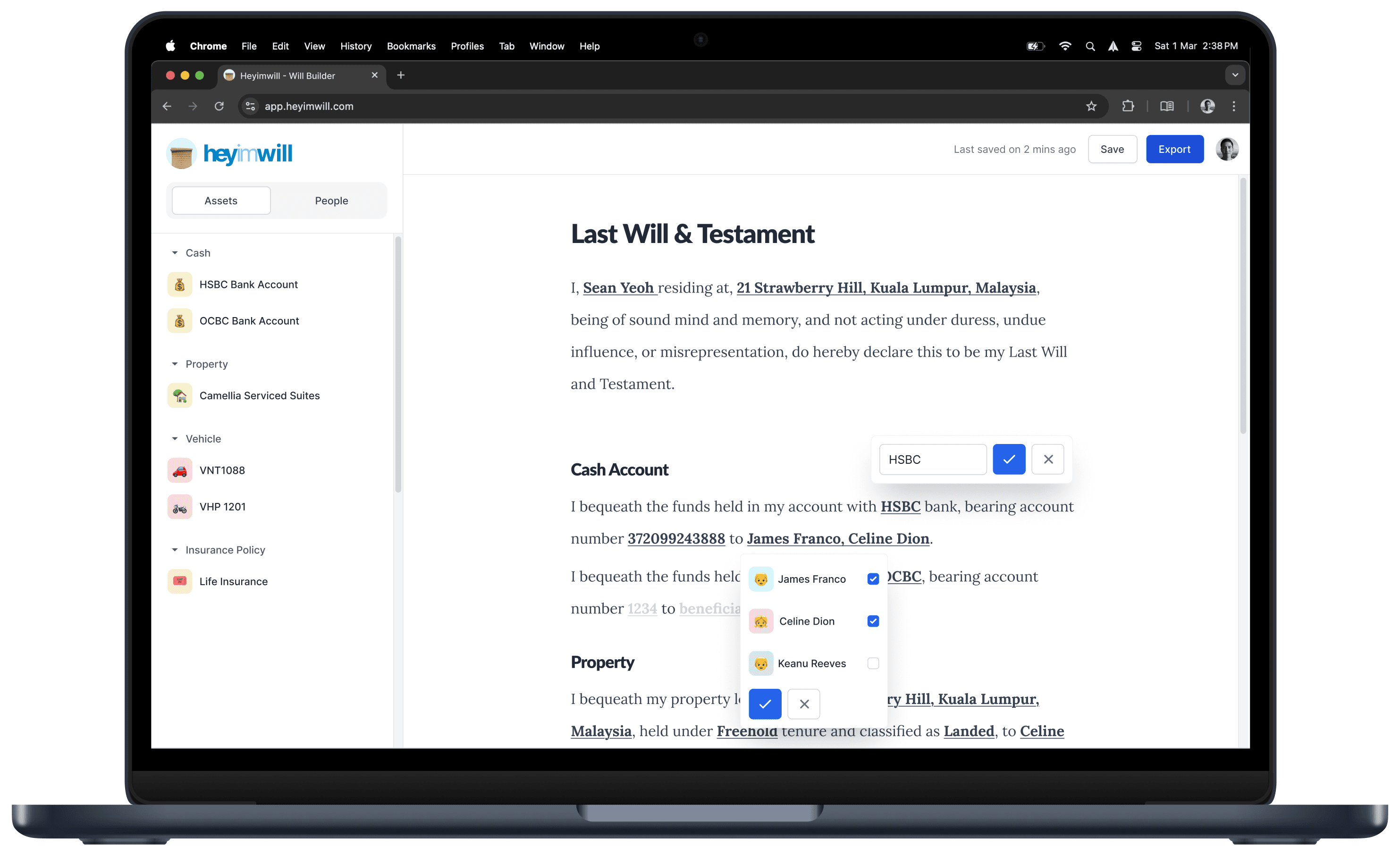
What Assets Should You Include in Your Will?
In short: Include everything your estate owns — bank accounts, property, vehicles, investments, business interests, and digital assets. But know this: your EPF savings and any nominated insurance payouts do NOT pass through your will. They go straight to your nominee, and a will cannot override those nominations. So your real job is two-fold: put the right assets in your will, and keep your EPF/insurance nominations updated separately.
When I listed my own assets, I started with the obvious ones and quickly realised how many things are easy to forget — and how some of my biggest assets weren't controlled by my will at all. Here's how to think about it.
This guide covers non-Muslims in Peninsular Malaysia. Muslims are subject to faraid and different nomination rules; Sabah and Sarawak may have different property and succession frameworks. Not legal advice.
The two-bucket framework
Before listing anything, understand that Malaysian assets fall into two buckets:
| Bucket | What it means | Examples | | --- | --- | --- | | Estate assets | Pass through your will (or intestacy if no will) | Bank accounts, most property, shares, car, valuables | | Non-estate assets | Bypass your will entirely — separate rules apply | EPF with valid nomination, nominated life insurance/takaful, some joint property |
Your will only controls bucket one. The most expensive mistake in Malaysian estate planning is treating everything as bucket one.
What your will controls (include these)
These assets form part of your estate and should be covered by your will:
- Bank accounts — local and foreign (sole-name accounts; joint accounts depend on mandate)
- Real property — houses, land (note: jointly-held property may pass by survivorship — see below)
- Vehicles — registered in your sole name
- Investments — shares, unit trusts, bonds, brokerage accounts, robo-advisor portfolios
- Business interests — shares in a private company, partnership stakes
- Cash, jewellery, and valuables
- Digital assets — crypto wallets, domains, monetised accounts (increasingly important)
- Personal and sentimental items
- Guardianship wishes for minor children, and care instructions for pets
- Intellectual property — if you own copyrights, patents, or royalty streams
A practical tip that saved my lawyer a lot of guesswork: don't just name the asset — record enough detail for your executor to find it (which bank, roughly where documents are kept). A will that lists "my bank accounts" without helping the executor locate them creates work and delay. See how to choose an executor.
Assets that may sit outside your will
| Asset type | Why it may bypass your will | | --- | --- | | EPF with valid nomination | Paid directly to nominee (EPF Reg 7(2)) | | Life insurance / takaful with nomination | Paid to nominee per FSA 2013 Sch 10 | | Joint-tenant property | Survivorship — passes to co-owner automatically | | Accounts with "payable on death" mandate | Depends on bank policy; check your mandate | | Employee share options (unvested) | May lapse or follow company scheme rules |
What your will does NOT control: the EPF trap
This is the single most misunderstood thing about Malaysian estate planning.
The law: EPF Regulations 2001, Regulation 7(2)
Under the Employees Provident Fund Act 1991 and EPF Regulations 2001, when you make a valid EPF nomination, that nomination governs who receives your EPF savings when you die. The critical provision is Regulation 7(2):
"A nomination made under this regulation shall not be revoked by any will."
Read that again. Your will cannot revoke, override, or change your EPF nomination. Not even if your will is newer, clearer, or drafted by the best lawyer in KL. The nomination stands on its own.
How EPF nominations work
| Scenario | What happens to your EPF | | --- | --- | | Valid nomination exists | EPF pays nominee(s) directly — money never enters your estate | | No valid nomination | EPF forms part of your estate; released only after probate/Letters of Administration | | Nomination revoked by marriage | EPF nomination is automatically revoked when you marry (Reg 6) — you must re-nominate | | Outdated nomination | Old nominee still receives — your will cannot fix this |
Why this matters in practice
EPF is often a person's largest liquid asset — hundreds of thousands of ringgit. Because it bypasses the estate, it's also released faster than bank accounts locked behind probate. That's good news if your nomination is correct. It's disastrous if it isn't.
Common EPF nomination mistakes:
- Nominated an ex-girlfriend years ago and never updated
- Nominated parents while single, then married but forgot to re-nominate (marriage revokes EPF nomination)
- Nominated sibling when you meant spouse to receive everything
- Split nomination percentages that no longer match your wishes
- Assumed your will would "sort it out later"
EPF vs will: side-by-side
| | EPF nomination | Your will | | --- | --- | --- | | Governs | EPF savings only | All other estate assets | | Can override the other? | EPF nomination wins for EPF | Will cannot touch EPF | | How to change | EPF Form KWAP 3 (or online via i-Akaun) | New will or codicil | | Revoked by marriage? | Yes (EPF Reg 6) | Yes (Wills Act 1959 s.12) | | Speed on death | Fast — direct payment to nominee | Slow — requires probate |
What your will does NOT control: the insurance/takaful trap
The law: Financial Services Act 2013, Schedule 10
Life insurance and takaful policies with nominations are governed by Schedule 10 of the Financial Services Act 2013 (FSA 2013). Three paragraphs matter most:
#### Paragraph 3(2) — the override rule
"A nomination under this Schedule shall not be revoked by any will."
Same principle as EPF: your will cannot override an insurance nomination. To change who benefits, you must update the nomination with your insurer/takaful operator directly.
#### Paragraph 5(1) — beneficial nominees (spouse, child, parent)
"Where the nominee is the spouse, child or parent of the policy owner, the nominee shall receive the policy moneys beneficially."
If your nominee is your spouse, child, or parent, they receive the payout as their own money — beneficially. They are not holding it on trust for anyone else. The money does not form part of your estate and is not distributed under your will.
#### Paragraph 6 — trustee nominees (everyone else)
"Where the nominee is not the spouse, child or parent of the policy owner, the nominee shall receive the policy moneys as an executor."
If your nominee is anyone else — a sibling, friend, business partner, niece — they receive the payout as an executor/trustee, not as beneficial owner. They must hold the money and distribute it according to:
- 1Your will (if you have one), or
- 2The Distribution Act 1958 (if you die intestate)
This is a crucial distinction most people miss.
Nominee type comparison
| Nominee relationship | Legal status | Who actually benefits | | --- | --- | --- | | Spouse | Beneficial nominee (Sch 10 para 5(1)) | Spouse — outright | | Child | Beneficial nominee | Child — outright | | Parent | Beneficial nominee | Parent — outright | | Sibling | Trustee/executor nominee (Sch 10 para 6) | Whoever your will says — or Distribution Act | | Friend | Trustee/executor nominee | Whoever your will says — or Distribution Act | | Business partner | Trustee/executor nominee | Whoever your will says — or Distribution Act |
What this means in practice
If your will says one thing and your EPF/insurance nomination says another, the nomination wins for those assets. You can't fix this in your will — you fix it by updating the nomination directly with EPF and your insurer.
For beneficial nominees (spouse/child/parent): the money is theirs. Your will is irrelevant.
For trustee nominees (everyone else): the money passes through their hands. Your will controls the ultimate distribution — but the nominee is the person who physically receives the cheque and is legally responsible for passing it on. Choose trustee nominees carefully.
Worked example: Priya's nomination mismatch
Priya a/l Rajan, 38, marketing director in Penang, dies unexpectedly. She left a will leaving everything to her husband Arvind. But her asset setup tells a different story:
| Asset | Value (approx.) | Nomination / title | What actually happens | | --- | --- | --- | --- | | EPF Account 1 + 2 | RM280,000 | Nominee: brother Kumar (made when single, never updated) | Kumar receives RM280,000 directly — bypasses will and Arvind | | Life insurance (Great Eastern) | RM500,000 | Nominee: Arvind (spouse) | Arvind receives beneficially — his outright | | Family condo | RM650,000 | Joint names with Arvind (joint tenants) | Passes to Arvind by survivorship — outside will | | Maybank savings | RM85,000 | Sole name, no nomination | Forms part of estate — distributed per will via probate | | ASB account | RM40,000 | Sole name | Forms part of estate | | Car | RM45,000 | Registered to Priya | Forms part of estate |
The result Arvind expected: Everything to him (~RM1.6 million).
The result Arvind actually got:
- Condo: RM650,000 (survivorship) ✓
- Insurance: RM500,000 (beneficial nominee) ✓
- EPF: RM0 — Kumar received RM280,000
- Estate assets (bank + ASB + car): RM170,000 via probate (minus legal fees and debts)
Arvind lost RM280,000 because Priya assumed her will would override an old EPF nomination. It cannot. Regulation 7(2) and Schedule 10 paragraph 3(2) are explicit.
What Priya should have done:
- 1Logged into EPF i-Akaun and updated nomination to Arvind (100%)
- 2Confirmed insurance nomination still listed Arvind as spouse-beneficiary
- 3Listed estate assets (Maybank, ASB, car) in her will with enough detail for the executor
- 4Reviewed all nominations after her marriage to Arvind
Worked example 2: Trustee nominee scenario
Lee Wei Ming, 45, names his sister Mei Ling as nominee on his Prudential life policy (RM300,000). Mei Ling is not his spouse, child, or parent — so under FSA 2013 Sch 10 para 6, she receives the payout as trustee/executor.
Lee's will leaves everything to his wife Susan and their two children equally.
What happens:
- 1Prudential pays RM300,000 to Mei Ling (as trustee nominee)
- 2Mei Ling is legally obligated to distribute per Lee's will
- 3Susan and the children each receive their share of the RM300,000 through Mei Ling
The risk: If Mei Ling doesn't cooperate, or if Lee had no will, the RM300,000 would be distributed under the Distribution Act 1958 instead. Lee chose Mei Ling as nominee probably because she was "trustworthy" — but a beneficial nomination to Susan would have been simpler and safer.
Lesson: If you want your spouse/child/parent to benefit directly from insurance, nominate them — don't nominate a sibling "to hold on their behalf."
Jointly-held property: survivorship vs tenants-in-common
| Ownership type | On your death | Controlled by will? | | --- | --- | --- | | Joint tenants | Your share passes to surviving co-owner automatically | No — survivorship applies | | Tenants-in-common | Your share forms part of your estate | Yes — will governs your share |
Most Malaysian family homes are held as joint tenants — so the surviving spouse typically gets the property regardless of what the will says. Check your title / geran if unsure. This is separate from EPF/insurance but catches people the same way.
Digital assets: include them, but be careful how
Cryptocurrency, domain names, monetised YouTube channels, NFTs, and online business accounts are assets your will can deal with. The challenge is access:
- Do list what you own and where (exchange name, wallet type, domain registrar)
- Do give your executor a secure way to access credentials (password manager, sealed letter)
- Don't write private keys or passwords directly in your will (wills become public documents during probate)
Edge cases and common mistakes
Mistake 1: "My will leaves everything to my spouse, so we're fine"
Your will only controls estate assets. EPF, insurance, and joint property may follow completely different paths. Audit all three layers: will, nominations, and title.
Mistake 2: Forgetting EPF nomination is revoked by marriage
Under EPF Reg 6, marriage revokes your existing EPF nomination — just like Wills Act s.12 revokes your will. Newlyweds often have no valid EPF nomination until they re-nominate. If you die before re-nominating, EPF falls into your estate (slower, via probate).
Mistake 3: Nominating a sibling "for convenience"
Under Sch 10 para 6, non-family nominees are trustees — not beneficial owners. This adds an unnecessary middle step. Nominate your spouse/child/parent if you want them to receive directly.
Mistake 4: Listing EPF in your will as if you control it
"I leave my EPF savings to my wife" — this clause is legally ineffective if you have a valid nomination naming someone else. It doesn't hurt, but it creates false confidence. Fix the nomination.
Mistake 5: Ignoring foreign assets
A Malaysian will can cover foreign assets, but foreign banks and land registries may require separate probate in that jurisdiction. List them anyway; get advice for significant overseas holdings.
Mistake 6: Vague asset descriptions
"My investments" is not enough. "Approximately RM50,000 in units held with Maybank Kim Eng, account ending 4821" helps your executor enormously.
Edge case: No nomination AND no will
EPF and insurance form part of your estate and are distributed under the Distribution Act 1958 — a fixed formula that may not match your wishes. See dying without a will.
Edge case: Muslim policyholder
Muslims may face additional restrictions on who can be nominated on takaful/life policies. Nomination rules interact with faraid. This article focuses on non-Muslim rules; Muslim readers should consult a qualified adviser.
Practical checklist: assets and nominations
Estate assets (your will):
- [ ] Listed all sole-name bank accounts (with bank name hints)
- [ ] Listed property (and confirmed joint tenant vs tenants-in-common)
- [ ] Listed vehicles, investments, business interests
- [ ] Listed digital assets with access instructions (separate from will)
- [ ] Included guardianship wishes for minor children
- [ ] Included personal items and sentimental gifts if desired
Non-estate assets (separate action required):
- [ ] Checked EPF nomination via i-Akaun — matches current wishes
- [ ] Re-nominated EPF after any marriage
- [ ] Checked every life insurance / takaful policy nomination
- [ ] Confirmed beneficial nominees (spouse/child/parent) where intended
- [ ] Reviewed trustee nominees — still appropriate and trustworthy
- [ ] Checked joint property title — understand survivorship implications
Ongoing:
- [ ] Revisit after marriage, divorce, new child, or major asset purchase
- [ ] Tell your executor where to find the asset list and nominations
- [ ] See updating your will
Frequently asked questions
- Does my will cover my EPF savings in Malaysia?
- Usually no. A valid EPF nomination cannot be revoked by a will (EPF Regulations 2001, Reg 7(2)), so EPF pays your nominee directly and the money bypasses your estate. Only if you have no valid nomination does your EPF fall into the estate and get distributed via your will or intestacy. Update your EPF nomination separately via i-Akaun or Form KWAP 3.
- Can my will override my insurance nomination?
- No. Under FSA 2013 Schedule 10, paragraph 3(2), a will cannot override an insurance nomination. If your nominee is your spouse, child, or parent, they receive the payout beneficially (para 5(1)); if it's someone else, they receive it as trustee to distribute per your will or the Distribution Act (para 6). To change who benefits, update the nomination with your insurer.
- What is the difference between a beneficial nominee and a trustee nominee?
- A beneficial nominee (spouse, child, or parent under Sch 10 para 5(1)) receives insurance money as their own — it never enters your estate. A trustee nominee (anyone else under para 6) receives the money as an executor and must pass it on according to your will or intestacy. Beneficial nominations are simpler and avoid a middle person.
- What assets should I include in my will?
- Include everything in your estate: bank accounts, property (your share), vehicles, investments, business interests, cash, valuables, digital assets, and personal items. Also record guardianship wishes for minor children. Exclude assets that pass by nomination (EPF, nominated insurance) or by survivorship (joint-tenant property), and handle those separately.
- Are digital assets like crypto covered by a Malaysian will?
- Yes — cryptocurrency, domains, and monetised online accounts are assets that can be dealt with in your will. Because they can be impossible to access without keys or credentials, the challenge is practical: give your executor a secure way to locate and access them, without writing private keys into the will itself.
- What happens to jointly-owned property when I die?
- It depends how the property is held. Property held as joint tenants generally passes automatically to the surviving co-owner outside your will, while property held as tenants-in-common passes through your estate. Check your title and get advice if you're unsure.
- Does marriage affect my EPF nomination?
- Yes. Under EPF Reg 6, marriage automatically revokes your existing EPF nomination. You must make a new nomination after marrying. This is separate from but parallel to Wills Act s.12, which revokes your will on marriage.
- What happens if I have no EPF nomination and no will?
- Your EPF forms part of your estate and is distributed under the Distribution Act 1958 after someone obtains Letters of Administration — a slower process than a direct nominee payment. This is why keeping an updated nomination matters even if you have a will.
Ready to write your will?
Build your will online and secure peace of mind for your loved ones.
Create Will